

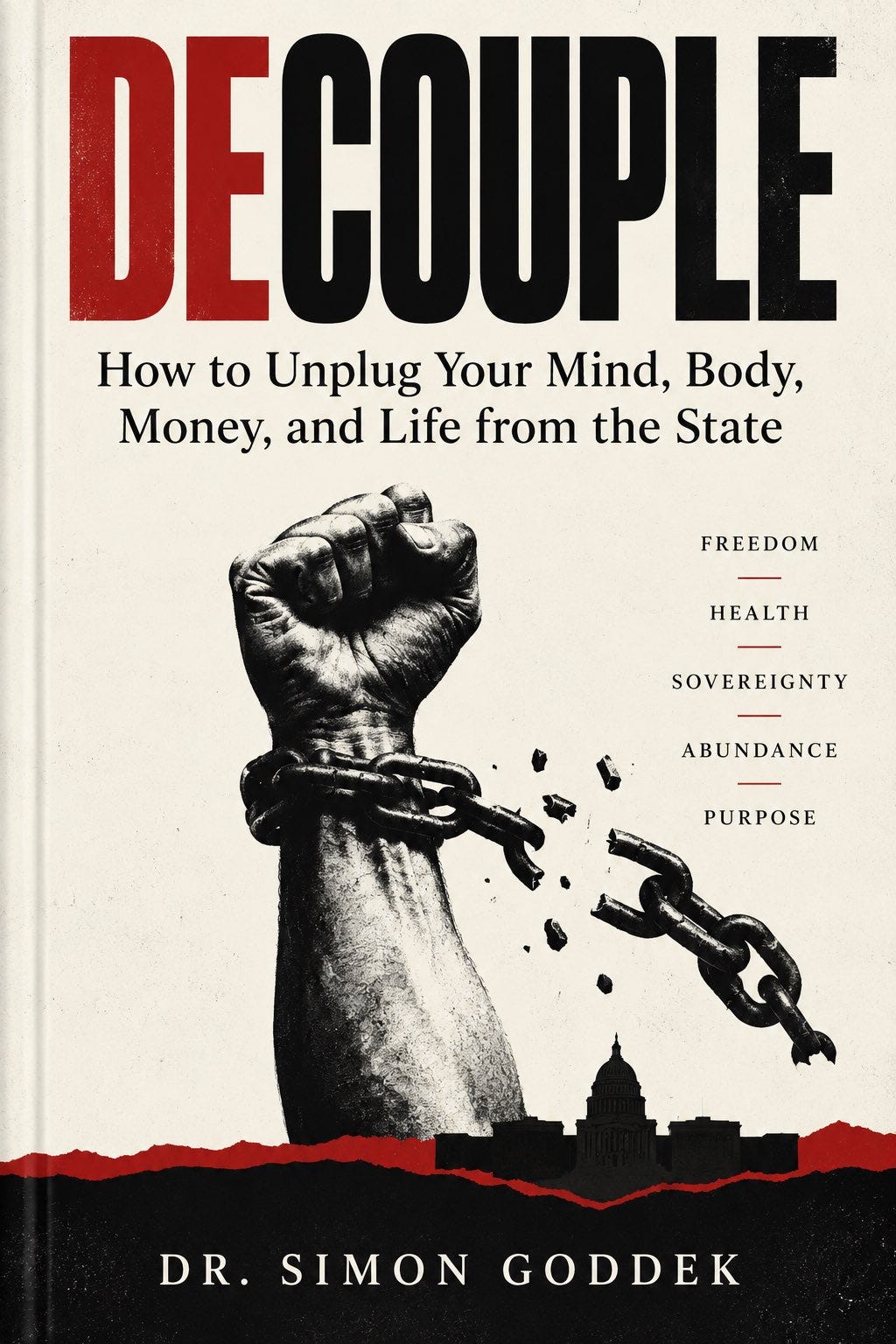
My upcoming book on freedom, self-sufficiency, and reclaiming control over your life. Today, I’m sharing its first chapter for the first time.
After years of research, countless personal experiences, and ultimately leaving conventional society behind to build an off-grid life in the Brazilian jungle, I’ve finally finished writing my book.
It’s called DECOUPLE: How to Unplug Your Mind, Body, Money, and Life from the State.
More than 800 pages. No political correctness, no sugarcoating… just the knowledge, practical tools, and lessons I’ve accumulated on my journey toward genuine independence.
I’m happy to announce that the book will be published in collaboration with a world-renowned publisher, with its release planned for the coming months.
But before that happens, I want to share something with you: the complete Chapter Zero of DECOUPLE, available to read for free below.
The central premise of my book is simple:
Your government doesn’t care about you.
Politicians don’t lose sleep over your declining purchasing power, your deteriorating health, or your growing dependence on institutions. They promise you security while steadily expanding their control over your money, your choices, and your future.
And here’s the uncomfortable truth: Voting for a different politician every four years won’t fundamentally change any of that.
I eventually realized that the most effective way to fight a system built on dependency isn’t to spend your entire life protesting against it. It’s to make yourself as independent of that system as possible.
That’s exactly what I’ve been doing.
I left Europe, moved into the Brazilian mountains, built my own energy infrastructure, started producing my own food, and gradually eliminated dependencies that most people consider unavoidable.
Not because it’s easy, but because I believe freedom is worth the effort.
And that’s what DECOUPLE is about. It’s not another book telling you what’s wrong with the world. There are already thousands of those.
It’s a practical instruction manual for doing something about it.
Whether it’s your health, finances, energy, food supply, digital privacy, or personal sovereignty, the goal is the same: to put you back in control.
You don’t need to move into the jungle to benefit from these ideas. You don’t even need to agree with everything I say.
You just need to understand one fundamental principle:
The less you depend on institutions that don’t have your best interests at heart, the harder it becomes for them to control you.
Below is the Chapter Zero of my upcoming book. I hope it inspires you to question some assumptions, reconsider your dependencies, and perhaps begin your own journey toward independence.
After all, where there’s a will, there’s a way.
Chapter Zero: How to Think About Causes
In April 1912, the largest moving object human beings had ever built hit an iceberg in the North Atlantic and sank. Roughly fifteen hundred people drowned in the freezing dark. You know this story. Almost everyone who has lived since that night knows this story. And that is exactly why I want to start a book about freedom with it. The sinking of the Titanic is the clearest demonstration I know of a truth the rest of this book depends on, and which almost no one is ever taught to see.
Here is the truth. If the Titanic had not sunk, you would almost certainly not exist.
Not you specifically, and not most of the people you know. This is not a poetic flourish. It follows from a branch of mathematics called chaos theory, and the Titanic is the clearest illustration of it I can think of. The central idea has a precise name: sensitive dependence on initial conditions. It means that in certain systems, a vanishingly small change at the start can produce an enormous and unpredictable difference later on. The popular name for it is the butterfly effect, after the meteorologist Edward Lorenz. In the 1960s he discovered that rounding a single number in a weather simulation from six decimal places to three completely transformed the forecast. He later asked, in the title of a famous lecture, whether the flap of a butterfly’s wings in Brazil might set off a tornado in Texas. Human history is exactly that kind of system, and I am going to show you the butterfly’s wings.
Why you are a child of the Titanic
The engine of the whole thing is conception. A human being begins when one particular sperm, out of many hundreds of millions, reaches an egg. Which one arrives is decided by differences of timing and position so small they are almost beyond measuring. The scale of the lottery is staggering. A man’s body manufactures sperm continuously, roughly fifteen hundred new cells every second, on the order of a hundred and thirty million a day. A single act of conception sends two to three hundred million of them racing toward one egg. Which one wins is a matter of seconds and millimetres. Shift the moment by a heartbeat, an inch, a quarter of an hour, and a different sperm arrives. That does not produce a slightly altered child. It produces an entirely different person, carrying a different half of the father’s genome.
The sensitivity runs deeper still. Each of those hundreds of millions of sperm is a unique genetic combination, freshly assembled by cell division and taking some sixty-four to seventy-two days to mature. So the very contents of the pool are themselves the product of timing that stretches back months. The identity of a child is balanced on a knife-edge of timing at every scale at once, from the second to the season. For all practical purposes there is exactly one unbroken sequence of moments that produces you. The smallest disturbance anywhere along it produces someone else instead.
Now apply the butterfly effect. The sinking was not a private tragedy. It was a global shock, on the front page of every newspaper on earth within days, rearranging the conversation, the mood, and the rhythm of an entire planet, however slightly. Every couple whose evening was altered by even a few minutes because of it, a delayed conversation, a changed mood, a night’s intimacy postponed, conceived a different child than they otherwise would have, or conceived on a different night, or did not conceive at all.
And here is the part that makes the claim total rather than partial. You might object that vast numbers of people in 1912, in remote villages and on distant continents, never heard of the Titanic at all. You would be right. It does not matter. The people who were affected went on to interact with people who weren’t, who interacted with others still. The perturbation spreads outward through the network of human contact in what is called a causal cascade, or a ripple effect. A man whose day was altered crosses paths a little differently with a neighbour who never read a newspaper in his life, and now the neighbour’s day is altered too, and in time his children’s conceptions with it. In a sufficiently connected world, no one stands outside the web. An initial disturbance, given a little time, propagates to everyone, including those it never directly touched.
The conclusion is therefore not modest, and it is not rhetorical. Essentially every human being conceived after that night in April 1912, which is to say very nearly everyone alive on earth today, is a different person than would have existed had that ship completed its crossing. The Titanic did not merely kill some fifteen hundred people. It quietly replaced most of the human race that was to come with a different one, and you are, in all probability, one of the replacements. We live on a single timeline among countless others that might have been, and we reached it through the eye of a needle.
Now follow the logic where it leads, because it does not stop at shipwrecks, and this is where it becomes genuinely uncomfortable. The same reasoning applies to every large event, including the monstrous ones. The First World War, the Second, the famines and the purges, the regimes of Stalin and Hitler and Mao, each of these convulsed the daily rhythm of billions of lives more violently than any sinking ship. So each of them, by the identical mechanism, determined who was and was not conceived in the years and decades that followed.
Which yields a conclusion no decent person can comfortably hold and no honest person can entirely escape: following this logic to the end, essentially every one of us alive today owes our specific existence, in part, to the worst men and the worst horrors in human history. We are, every one of us, children of the catastrophes. I do not raise this to be ghoulish, and certainly not to launder a single one of those crimes, which remain exactly as evil as they were. I raise it because it is the final proof of how strange and how unsentimental causality actually is. The web of cause and effect does not care about our moral categories. It propagates through saints and tyrants alike, and a mind that wants to see the world as it truly is, rather than as it would prefer it to be, has to be willing to follow the strings even into places it would rather they did not go.
If that still feels too abstract, here is the same principle with a sharper edge. In 1997 a film was made about the disaster and became, for a time, the most-watched motion picture in history. Hundreds of millions saw it, many on dates, and the timing of the conceptions that followed those dates was set by the runtime of the film, the queue at the box office, the conversation in the car afterward. By the same sensitive dependence, a large share of everyone born in the Western world after 1998 owes the precise moment of their creation, and therefore their entire existence, to a Hollywood director’s choices about how to dramatise a shipwreck from eighty-five years before. Children of the Titanic twice over: once for the ship, and once for the film about the ship. The fact that this sounds absurd is not a flaw in the reasoning. It is a measure of how poorly we are taught to think about how causes actually move through the world.
The wrong turn
Now let me run the same idea in the opposite direction, because it teaches the other half of the lesson.
On the 28th of June 1914, in Sarajevo, a driver named Leopold Lojka took a wrong turn. He was carrying the Archduke Franz Ferdinand, heir to the Austro-Hungarian throne, and earlier that day assassins had already failed to kill the Archduke once, a bomb thrown and missed. Now, hours later, Lojka turned down the wrong street, realised his error, and stopped the car to reverse. By an almost unbelievable coincidence he stopped it directly in front of Gavrilo Princip, one of the conspirators, who had given up for the day and wandered off to buy something to eat. Princip could not believe his luck. He stepped forward and fired twice, and the shots he fired are generally reckoned to have lit the fuse of the First World War, which killed some twenty million people, toppled four empires, birthed the Russian Revolution and with it the rise of communism that would go on to kill well over a hundred million more across the century, and set the stage for the Second World War and everything that followed from it.
Now ask the question this book wants you to learn to ask. What caused that wrong turn? And notice that the honest answer is: we cannot fully know, and it was almost certainly many small things at once. Perhaps Lojka had slept badly. Perhaps he was rattled, as any man would be, by the bomb that had already exploded that morning. Perhaps he had been given hurried, confusing directions in the chaos after the first attack. Perhaps he had quarrelled with someone over breakfast and was driving with half his mind elsewhere. Perhaps it was simply a momentary lapse, the kind every driver has a hundred times a year, that happened this once to fall in the worst possible place at the worst possible moment. Any one of these trivial, forgettable, intensely human things may have set the car in front of the gun, and through it, arguably, redirected the entire twentieth century.
This is the second half of the lesson, and it is as important as the first. Not only do tiny causes produce vast effects, but every large outcome sits on top of a hidden mountain of small causes that we can rarely reconstruct in full. History is not a chain of grand inevitabilities. It is a fragile, contingent, accident-prone thing, balanced at every moment on a thousand small pivots, any of which might have tipped the other way. The timeline you live in is not the only one that could have been. It is merely the one that happened, and it happened by a margin as thin as a tired driver’s attention on a summer morning.
My own wrong turn
I will give you one more, closer to home, because contingency is not only a property of famous disasters. It is the shape of every life, including yours, and including mine.
Had a particular American virologist, Dr Anthony Fauci, not directed his agency’s funding toward the gain-of-function research underway in a laboratory in Wuhan, and had a virus consequently not emerged from that city in late 2019, and had the world’s governments not responded to it as they did, I would in all likelihood be a full professor today. I was on the track for it. I would be teaching at a respected European university, drawing a respectable salary, publishing my papers, comfortable and secure and esteemed. I would still have been a sceptical man and an independent thinker, because that is my nature. But I would never have been forced to discover, in my own flesh and career, just how far the rot in our institutions actually goes. I would have remained a critical mind that had never been pushed to the wall, and so had never learned what is on the other side of it. The man writing this book, on a mountain in the jungle, powered by the sun, free in a way I did not know was possible, exists only because a catastrophe fell across my life and knocked me off the comfortable track I was on. The worst thing that happened to me was the hinge on which my freedom turned. Hold that thought, because it is the seed of everything that follows: the contingency that looks like ruin is very often the doorway out.
How causes actually work
So contingency is real and history is fragile. Now I have to give you the toolkit, the small set of ideas you need to think clearly about causes, because the people who wish to manage you rely absolutely on your not having them. The whole machinery of propaganda, bad science, and political manipulation runs on simple stories, X caused Y, told to people who have never been equipped to notice that the truth is almost always more complicated. Here are the tools. They are not difficult. They are merely seldom taught, and I suspect that is not an accident.
First, a small matter of vocabulary, because you cannot think clearly with muddled words, and these four are constantly confused. A variable is simply a thing that can change, that can take different values: the amount of sunlight you get, the dose of a drug, the hours you sleep. A parameter is different, and the distinction matters more than it first appears. A parameter is the setting that governs how strongly a variable acts, the rule that decides how much its changing matters. Two people can eat the identical amount of sugar, the same variable, and one barely stirs while the other’s blood glucose spikes violently, because their genetics, the parameter, set a different sensitivity. The variable is what moves; the parameter is the rule that determines how much the movement counts. A factor is anything that contributes to an outcome: seed oils, stress, and poor sleep are all factors in chronic inflammation. And an aspect is a feature or dimension of a thing that is not itself a cause at all. The colour of a flame is an aspect of the fire; it does not cause the fire, and a person who set out to change the temperature by painting the flame would be making a precise version of an error people make constantly, mistaking a feature of a thing for a lever that controls it.
Second, and this is the most useful single idea in the entire toolkit: correlation is not causation. Two things moving together does not mean one causes the other. When ice cream sales rise, drownings rise, and the two track each other closely through the year, but ice cream does not drown anyone. A third thing, summer heat, causes both: it drives people to buy ice cream and it drives them into the water. That hidden third thing is called a confounder, and once you learn to look for it you will see it everywhere, quietly manufacturing fake causes out of innocent coincidences. A vast amount of what is sold to you as scientific finding, as health advice, as news, is a correlation with the confounder carefully left out, because the confounder would spoil the story someone wished to tell. When you are told that A causes B, the first question of a free mind is always: or does some third thing cause both?
Third, the headline truth from which everything else follows: outside rare and genuinely isolated cases, X almost never simply causes Y. Real outcomes are multifactorial. They are the product of many factors interacting at once, and the single-arrow story, this one thing caused that one thing, is nearly always a simplification, and very often a deliberate one. To see this clearly, take a question that matters to every reader of this book: what causes a heart attack?
The simple story, the one repeated for decades, names a single villain, cholesterol, a clogged pipe, eat less fat and you are safe. Now open the hood. A heart attack is the end point of a vast web of interacting causes. There is chronic inflammation, and insulin resistance, and the consumption of industrial seed oils, and smoking, and chronic stress with its flood of cortisol, and poor sleep, and a sedentary life, and deficiencies of particular nutrients, and yes, among all of these, blood lipids, though in a far more complicated role than the simple story allows. Over each of these factors sits a parameter, your individual genetics, which determines how strongly each one strikes you in particular. Between many of them run feedback loops: inflammation worsens insulin resistance, which worsens inflammation, a self-amplifying spiral of exactly the kind I will describe in Chapter Three, where you will meet the reinforcing loop and its opposite, the balancing loop, in full. And nearly all of it operates on long time delays, the seed oils consumed across twenty years, the artery quietly changing across decades, so that cause and effect are separated by so vast a gap that the connection is easy to deny and easy to hide. The honest answer to “what causes a heart attack” is not a word. It is a system. And the man who served you the one-word answer was very often selling the one-word solution that went with it.
This is the deepest reason the simple story is so dangerous, and so profitable. There is a precise tool for taking it apart, the distinction between a necessary cause and a sufficient one. A lit match is necessary for this particular fire, but it is not sufficient, because a match alone, with no fuel and no oxygen, burns out and nothing happens. The fire required the match and the dry wood and the air, all of them necessary, none of them alone sufficient. Hold that distinction up to almost any simple causal story you are told and watch it fall apart. The virus of 2020 was a necessary factor in who died, but it was nowhere near a sufficient cause, because the same virus met one body and passed through it like a cold and met another and killed it. The difference lay in all the other factors: the age, the metabolic health, the vitamin status, the chronic stress, the underlying disease. And here I will state plainly a conclusion that the official story was built to prevent you from reaching: I believe that a great many of the people counted as victims of the virus were in truth victims of the response to it. The aggressive and often inappropriate use of mechanical ventilators, which we now know harmed many patients who might have recovered without them. The isolation of the elderly, cut off from the human contact that was very likely keeping them alive, left to deteriorate and die alone. The relentless campaign of fear, which, as we saw in an earlier chapter, floods the body with the stress hormones that suppress the immune system precisely when it is most needed. These were not the virus. These were choices, and they were necessary causes of a great deal of death in their own right. A society that genuinely cared about preserving life, rather than about the appearance of decisive action and the management of a frightened population, would not have made them. To name the virus as the cause, full stop, while suppressing all discussion of the factors layered on top of it, including the ones the authorities themselves introduced, was to commit, deliberately, the exact error this chapter exists to inoculate you against, and a very great deal followed from that single sleight of hand.
Why this comes first
These tools are not academic, or rather, some of them are, and that is precisely the scandal. The causal-loop diagram I described drawing for my own illness is a perfectly standard instrument of systems science, taught and used in serious institutions for decades, and yet it is almost never turned on the questions that matter most, the origins of our diseases, the real drivers of our problems, because the picture it produces is a standing threat to every simple story that someone profitable is invested in defending. A tool that reveals the true tangle of causes is unwelcome wherever a single tidy cause has already been declared the settled science. They are the immune system of a free mind, and the reason I have placed them before everything else is that every argument in this book, and every manipulation outside it, turns on them. When someone tells you that one thing simply causes another, the spell only works if you cannot see the missing factors, the hidden confounder, the unexamined parameter, the loop, the delay, the difference between a thing that was necessary and a thing that was sufficient. Learn to see them and you become very difficult to fool, which is the entire object of the exercise.
Seeing the strings, and cutting them
But there is a further purpose to all of this, and it is the reason this primer belongs at the front of a book called Decouple rather than in some textbook on logic. Once you can see causes clearly, you can see the strings.
Picture your life for a moment as a thing suspended in a web of causal strings, each one a line of cause and effect running from somewhere in the outside world into your body, your mind, your money, your days. Some of those strings are benign or even good: the sun that strikes your skin and builds your health, the people who love you, the work of your own hands. But a great many of them, you will come to see, run from the machinery of the state and its allied industries directly into the quality and the freedom of your life, and they carry harm. The processed food that inflames your gut. The media that floods you with fear. The currency that quietly bleeds your savings. The licence you must beg for, the grid you cannot leave, the single passport that pins you in place. Each is a string, a real and traceable line of cause and effect, and most people cannot see a single one of them, which is exactly why they cannot understand why they feel sick, broke, anxious, and trapped despite doing everything they were told.
This is what the toolkit is for. The whole method of this book, chapter by chapter, is the same three movements applied to one domain of life after another. First, we trace the strings: we map the actual causes and effects running from the system into your life, the way I mapped the causes of my own illness onto a page until the loops revealed themselves. Second, we identify which strings carry harm: we separate the factors that damage you, your health, your wealth, your sovereignty, from the ones that serve you, using the very tools you have just learned, so that you are cutting real causes and not chasing aspects or confounders or simple stories. And third, we cut them: we sever the harmful causes at their source, one by one, and replace the dependency with something you control, which is the precise act that this book means by the word decouple.
To decouple is not to flee the world or to smash every connection in some adolescent tantrum against modernity. It is something far more surgical and far more intelligent. It is to see the web clearly, to find the specific strings by which the system reaches into your life and takes from it, to establish which of those strings are doing you harm, and then to cut those particular strings, deliberately and one at a time, while leaving the good ones intact. That is the whole programme, and you cannot do any of it without first being able to see cause and effect for what it really is, which is why we started here.
So carry with you, underneath the toolkit, the stranger and larger truth that the Titanic and the wrong turn and my own ruined career are all trying to show you: that the world is held together by causes far more numerous, far smaller, and far more fragile than we are comfortable admitting. Nothing was inevitable. The grain of sand moved the dune. A different sperm, a tired driver, a funded experiment in a far laboratory, and everything is otherwise. This should frighten you a little, and it should also free you, because a world that fragile is a world whose strings can be cut and retied by a person who can finally see them, including by you, including starting now.
That is the lens. Now let us look through it, beginning with the machine that has been quietly extracting the value of your life, and which you have been taught to call your government.
Enjoyed this first glimpse of DECOUPLE?
Subscribe to my Substack to follow the journey, get updates on the book’s upcoming release, and discover practical ways to become less dependent on the system.
Remember: Freedom isn’t granted. It’s built.